Monday, February 22, 2016

Abel Tasman National Park

We had hoped to go standby on the 2:45 pm ferry, but this was not to be.  So we parked in the shade of an overpass at the ferry terminal and read until cars started lining up for the 5pm ferry at 3:30 pm.  It’s a big ferry boat and they seemed to have a pretty careful loading system with 4 lanes of cars channeled on and crew to direct you to your exact parking spot on one of 2 car decks.  The ride over was quite comfortable and we saw some dolphins leaping in front of the boat about an hour into the 3 hour ride.  We got some dinner at the café, a piece of lasagna that was pretty decent.  You get to the Queen Charlotte Islands that form a fringe around the north central part of the South Island about an hour before arriving in Picton, on the South Island.  From there we drove 2 hours to Nelson.  The roads were pretty empty and the driving was easy until you get about a ½ hour from Nelson when they get narrow curvy.  And then when we got to Nelson suddenly there was a ton of traffic.  Jake asked someone in the opposite lane what event had just let out and the guy said it was the outdoor opera.  You can only imagine how Jake felt about the opera letting out slowing our already long day!  Our hotel had left the door open for us literally and bed was very welcome.

We didn’t get to see much of Nelson except for walking a few blocks into town for breakfast.  The hotel recommended The Lambretti, named after the Italian motor scooter.  It was a nice casual place with the standard assortment of breakfast menu items and good coffee.  A little Sunday outdoor market was going on with a motley assortment of second hand items, plants, foods, and some vegetables. 

Wilson Kayaks had left bags for us at the hotel desk, so we sorted out what we would take on our three day hiking/kayaking trip.  Then we drove about 45 minutes to Motueka further up the coast.  We were the first of our group to arrive, the rest were picked up by a shuttle bus.  We all did some further luggage/backpack sorting and picked up a bag lunch.  There were 7 couples in our group, but 4 were only going to be hiking.  Besides us there were two other American couples, one couple more or less our age from Ashland, OR who work as nurses and one younger couple who were in the process of moving from Boston to Denver.  Three of the other couples were British retirees and the last was a couple from Auckland who work for an Australian airline.  Our guides were John, a New Zealander who has worked around the park for 40+ years, and Squid, a young Brit who has worked as a guide seasonally for 3 years.  He and his wife came on a work-holiday visa for 2 years and now they have a temporary work visa as “essential workers” because I guess there aren’t enough experienced NZ guides.

Day one we took a boat ¾ of the way up the park’s coastline and it let us out at Tonga Quarry.  From the quarry we walked 7 km north to Meadowbank Homestead, a lodge on Awaroa Bay.  The walks take you over headlands and along beautiful golden sand beaches. John knows all the plants and showed me a parasitic orchid, the horned orchid that mimics its wasp pollinator, and lots of trees and vines.  He also talked about the effort to control yellow jackets using fipronil bait and control of gorse using introduced mites. The DOC is also killing pines in some areas to encourage regrowth of the native vegetation.  Goats are controlled as well as stoats. 

Meadowbank Homestead had been rebuilt from the original. It is run on solar power and seemed to try to be very eco-friendly.  The land was owned by a family that had settled and tried farming in the 1860s.  After having 9 children the wife tired of living in such an isolated location and she moved into town with the kids and started running a boarding house.  She fell in love with one of the boarders, married him, and had 2 more kids.  But he was a ne’er do well and a drunk.  One day he shot her to death.  Her first husband took in one of her last 2 kids but the other was adopted by another family.  Eventually he found his sister and half siblings again and was accepted by them.  Soap operas are nothing new.  (This was all relayed in a video of vintage still photos after dinner).  Before dinner we took a quick swim in the shallow estuary in front of the house.

Dinner was a communal affair.  You could choose a main course and dessert and everyone got the same side dishes and appetizer (or entrée as they are called here).  The first night was a choice between fish skewers and rack of lamb (the lamb was excellent, served in a rose wine sauce, the fish was overcooked).  Dessert was a very good slice of blue cheese with fruit chutney and crackers decorated with a nasturtium flower, or an apricot tart with a thick shortbread crust.  There were enough side dishes to satisfy vegetarians who don’t eat fish.   In the middle of the night we both woke up and went outside to look at the stars.  The sky was very dark and the stars looked so close.  The milky way was so full of stars it seemed hard to pick out any constellations unless they were at the edge of the sky.

The dead tree that appears on the first map of Torrent Bay
The estuary to be crossed
John demonstrating how palm fronds can be used as sleds
Fall River estuary
Day 2 we were served breakfast around 7:30 am, our choice of continental or cooked breakfast. They had set up snacks and sandwich makings that we could fix and bag for our lunch.  We crossed the wide estuary at low tide around 8:15 am wearing our sandals or water shoes, then changed into our hiking shoes for another 7 km walk to Totaranui.  This walked was similar to the previous day but passed through some examples of more mature foredune forest. At Totaranui we caught the ferry boat back down to Tonga Quarry.  Here the walking group separated from the kayak group.  Us kayakers did a quick walk to another nearby beach where our kayaks awaited us. After eating some of our bagged lunch we got safety and paddling instruction and then set off south for about an 8 km kayak to Torrent Bay.  We paddled in and out of a couple beautiful estuaries during the high tide and stopped for a snack on a sand spit.  The wind picked up as the afternoon went on and we were very happy to get around the last headland into Torrent Bay around 5pm. 

Sunset at Torrent Bay lodge
Sunset view at Torrent Bay
Nursing seal pup
Inquisitive south island robin
Split apple rock
The lodge on Torrent Bay is a little simpler but still very nice.  There was another group of 7 people at the end of a 5 day trip at the lodge as well as a young guy who was just spending one night there and not doing any hiking or kayaking.  He had dinner at our table and had been in Wellington for a week volunteering at a conference that his company had sent him too.  They had encouraged him to spend a few extra days vacationing.  He was from Ohio and now lives in South Carolina working for some sort of software company.  He seemed to be at that post college all knowing, eager, confident age.  Dinner choices were salmon or steak, both very good.  Dessert was a cheese plate or pavlova (meringue and cream) with slices of fresh kiwi. 

Sailing the last stretch
Day 3 dawned cloudy and we would be kayaking all day, about 12 km.  We launched as the tide was going out onto calm waters.  We started out across the “mad mile” which was pretty calm but a very rocky shoreline.  From there we went across a short channel to Adele Island, a bird sanctuary that has been cleared of stoats, rats and goats.  We watched 8 week old fur seals play on the rocks as the moms lolled about doing as little as possible (apparently at this stage they are pregnant again, so they are conserving energy between feeding the youngsters and getting ready for the next ones).  We landed at a small beach for a tea break.  Squid set up an umbrella since it was raining and brewed some kanuka leaf tea from leaves he had collected around the lodge.  It’s a very nice tea and apparently loaded with vitamins (no caffeine).  Capt. Cook reportedly favored it over Indian tea after trying it.    From the beach we crossed back over the channel to Apple Tree bay (someone had tried to grow an orchard there but there are no longer any apple trees left) and met up with the hikers for lunch.  We didn’t spend too long over lunch but the couple from Auckland caught the ferry back from there to catch their flight home and the couple from OR decided they had had enough kayaking and also caught the ferry back to Kaiteriteri where they would wait for us.  So it was down to the Denver couple and us and Squid.  We set off across the wide Marahau Bay and around the headland to Kaiteriteri.  The wind started to pick up as we reached the final headland, so we rafted up on either side of Squid’s kayak in the rolling sea and he got out a big square sale.  2 corners were tied with ropes to Jake and Johnnie’s paddles and Katie and I held onto the front corner straps.  It made a very effective sail and we made good time all the way into the Bay.  Katie got soaked though being on the windward side and I guess it was quite an effort to hold the paddles upright with the pressure on the sail. 

In Kaiteriteri (which means food very rapidly in Maori) we had time to change clothes and get a cup of coffee at a café before the bus picked us up to take us back to our car and the office.  We repacked and said our final farewells to our companions).  Jake and I didn’t have far to go as we were staying in Motueka at the Equestrian Lodge Motel for the night.  It was a nice place and our accommodation actually had 3 rooms.  So we could spread out our luggage, use the washer and dryer, and repack in comfort.  We had a nice dinner of fried fish and salad and NZ pinot gris for me at Elevation a few blocks away and restocked for breakfast at the New World supermarket

Wellington

We have accidentally spent more time in Wellington than intended.  My computer is still on US time and I neglected to realize that we were only supposed to spend 2 nights in Wellington.  We missed our ferry.  Then Jake rebooked not realizing he had left out passage for the car, so late Sat. afternoon we think we have passage for us and the car now.  We had to switch hotels too because ours was fully booked.

Diving on the Wellington waterfront
The good part is that we like Wellington, although I think we’ve seen about all the sites that we wanted to see.  We got here late afternoon and walked down to the waterfront harbor area.  It is well designed with lots of different sorts of spaces to hang out in.  The water seems to be pretty clean and there are a couple areas with diving platforms and floating docks.  The dragonboat teams practice and you can rent any number of different water sport items from paddleboards to sit on top kayaks.

Botanic Garden rose garden
Eternal flame
The first morning I explored the botanic garden at the top of the cable car line.  It is nicely laid out with lots of different garden styles and a lengthy network of paths.  The visitor information center is located in the center of the garden more or less with a view into the tree canopy.  At the bottom of the garden are the glass houses with a café and small gift shop.  There is a flat area there reclaimed from a former cemetery that is now a huge rose garden.  And sitting quietly off to the side is a small garden space where the peace flame sits over a small pond with a waterfall blocking out background noises.

In the afternoon we explored the Te Papa Museum, an enormous museum covering everything from art to social history to natural history.  There are very good exhibits on New Zealand’s social history covering the Maori tribes settlement of the islands, the arrival of the British, and more recent social issues such as LGBTI rights.  The Natural History floor had a fun little earthquake simulator, but warning signs to parents whose children may have been traumatized by the Christchurch earthquake in 2011.  They also had footage of the eruption of Mt. Tongariro in 2012.  There was a nicely designed exhibit of shells and birds that made it easy to id them.  There was also an interactive exhibit on native and introduced fauna.  The third floor was about people and the environment.  It starts with a room where you can pretend you’re a customs inspector searching for unwanted plants and animals.  They also talk about the impacts from agriculture and the timber industry.  The Maori used fire and cultivated land extensively, so by the time the Europeans settled NZ had lost about 30% of its forest cover if I remember right.  It has now lost an additional 50%. 

After absorbing all the information we could stand, we went and sat on Oriental Beach for awhile.
In the evening the area near the museum had a Cuban band playing so we listened to that and danced a little before going in search of dinner.  We ended up at one of the places on the water, Bin44, where Jake got green lipped mussels and I got snapper served with steamed vegetables. It was good, I’d go there for the view more than the food.  Lunch I would rate similarly.  We decided on Chinese in honor of Chinese New Year and ate at Jasmin near our hotel.  It was a relatively inexpensive buffet of decent Chinese food.

On the morning of day 2 (after rearranging our new ferry transport and hotel), I caught a bus up to the Wilton Bush Reserve, a native garden and reserve about 20 minutes from town.  They have very extensive native plant gardens that are very well designed and labeled.  The gardens are designed for different climate areas of the country.  They have also restored the surrounding forest and trees and labeled along the paths.  You can also pick up brochures for a nature walk and a NZ treasures walk that further describe particular plants or ecological relationships.  There didn’t seem to be many staff around but they do offer occasional guided walks (although none during our visit unfortunately).

In the afternoon we visited the old St. Pauls church built in 1856 in English gothic style, but out of local woods.  The woodwork is beautiful and there is a nice historical description of how the land was acquired probably illegally from the Maori and the church was built.  

Friday, February 19, 2016

Awaroa Bay

After seeing this location of lodgings (Awaroa Bay) after our first night on the trail, all was set for a beautiful Valentine’s evening.
  

The following night’s location, Torrent Bay (in the Abel Tasman National Park), after a rough day of kayaking, was pretty nice too.
 

Friday, February 12, 2016

Art Deco Napier

After the jet boat ride and a nice hot bowl of soup in town, we drove east across the mountains to Napier.  The road passes through more sheep and cattle country, and pine plantations.  At one point it gets very windy and narrow and it was a relief when a café hove into site for a stretching break.  The hills go pretty much right up to the ocean.  It is much drier on the east side of the mountains, a Mediterranean climate.  This region is home to the Hawke’s Bay vineyards.  There are lots of apple, plum and peach orchards too, often sheltered by 12' tall dense evergreen hedges.

Breakfast at the County Hotel with comb honey
Downtown Napier
Beach in Napier
Napier was rebuilt after a big earthquake in Art Deco style in the early 1930s, and you really could almost believe it was the 1930s.  We stayed at The County Hotel, a grand hotel downtown with beautiful wood work and brass fittings.  There was a lovely restaurant downstairs where we ended up eating both dinner and breakfast.  After dinner you could have a glass of port in the library.  Lots of people were using the Promenade along the ocean and gardens and fountains fill in space between the promenade and the smaller sidewalk along the street (as well as a skate park, a mini-golf course, and the ISite tourism building).  There was one great vintage clothing shop where I almost convinced Jake to get a striped jacket and straw boater's cap. 

Napier is also home to what may be the world’s only museum devoted to an invasive species.  Opossum World is half shop half museum.  The museum portion features large dioramas of the possum life cycle and eating habits and fur colors with stuffed and pickled possums of various sizes.  A couple posters describe the introduction of the possum from Australia for the fur trade.  They were introduced repeatedly by acclimatization societies.  Not too long after their introduction fruit farmers started noticing damage to their trees and so the fur trappers fought against the farmers on introduction versus eradication.  In the store you can buy many items made of a blend of merino wool, possum fur and silk as well as items made from possum pelts.  So a little of that tension between the pros and cons of possums may still be around!
Stuffed possums


From Napier we drove 4 hours south to Wellington.  That drive goes through flatter country until about the last hour when you go over a mountain range again.  On the way you go through a lot of little towns that seem to get progressively more prosperous the closer to Wellington you get. We stopped in a small town to split a sandwich (or sammie as they are called here) from the Lazy Graze café.  It had Holstein décor in the interior. Good sandwich and coffee!

Tuesday, February 9, 2016

Volcanos

Pines creep up a mountain on the road to Rotorua
After the cave tour we set out across sheep and cow country for Rotorua, about 2 hours away.  The road is pretty scenic and not heavily trafficked.  Rotorua is very touristy and a lot of places were booked because of the long weekend.  We used the ISite office to find lodging.  ISites are the NZ tourism board sites, very helpful places for booking lodging, tours and activities and picking up maps.  We walked from our hotel over to a trail along the river that feeds into Lake Rotorua.  A young girl helped us find it – she was a saucy lass on her way from her cousin’s to her brother’s hoping she didn’t get grounded for being home late.  She is the youngest of 14, the rest all brothers.  She wanted to know whether we had ever seen a gold Lamborghini in the US. 

Former landfill, now walking path in Rotorua
Former bath house, now museum in Rotorua
The walk was interesting, but long to downtown.  It led through a former sulfur mining site and later town dump that was being reclaimed as a natural area.  It looked pretty hellish in the thermally active sections with steam and sulfurous gases rising from the yellow and white earth. Apparently one entrepreneur built an  inexpensive bath, but it had to close down after several patrons drowned having passed out from the noxious gases that built up in the bathing rooms. The walk ends downtown at the very nice looking Polynesian spa and the museum housed in the Edwardian era bath house.  It is surrounded by bowling greens, croquet grounds and a rose garden.  Downtown has lots of shops and restaurants but seemed very quiet for a holiday weekend.  We ate at Capriccio, a small Italian pizza place in town.  We ended up chatting with Richard and Sarah, a couple from South Hampton, England who are also in NZ for a month.  They seemed to have been all over the world from the Galapagos to Pocomoke, MD to Australia.  She and I chatted about Words with Friends, while he and Jake discussed golf.  They are also sailors.

Prince's Feather geyser at Te Puia
Lowering food to be cooked in a steam vent
Tourists face Maori warriors
Very buff Maori 
The next day we went to Te Puia, a Maori thermal reserve just outside of town.  They offer a Maori cultural experience which although touristy, was fun and somewhat informative.  A tourist is chosen as the group’s chief and one of the Maori “chiefs” makes sure they are coming in peace and welcomes them.  After a brief display by the warriors everyone files into the ceremonial house to watch several styles of dancing and singing.  There is voluntary audience participating for a couple dances.

You can then wander around the thermal area which has bubbling pools of mud, geysers,  steam vents etc.  It’s all very civilized but reasonably well interpreted. There is also a carving school where you can watch students learning to do traditional carvings and ask questions.

boiling mud
We drove from Rotorua about 80 km to Taupo on a huge lake.  The town is as touristy as Rotorua but maybe slightly more oriented towards adventure tourism and fishing.  We didn’t stop at any of the thermal sites outside of town although there were many.  Seen one boiling mud pool seen them all?  It’s been very hard to choose among sites and still leave enough time to relax and not spend all day driving.

We got information on camping around the lake at the ISite and got groceries and an iced coffee for me in town.  We camped at a small holiday park in Motouapao on the west side of the lake almost at the south end.  We got a small camp site overlooking the water. There seem to be a lot of permanent privately owned sites within this little park and some very cute converted VW vans.  We are sandwiched between an unoccupied very large tent attached to a camper and a Jucy rental van.  It seems very quiet so far at least with just the sound of the birds and cicadas and a little background traffic noise from Rt. 1(Do  all route 1’s have a lot of traffic?). 
black swan on Lake Taupo
View from our Lake Taupo camp site
Cabin at Motuepa Holiday Park, see converted VW cabin in background
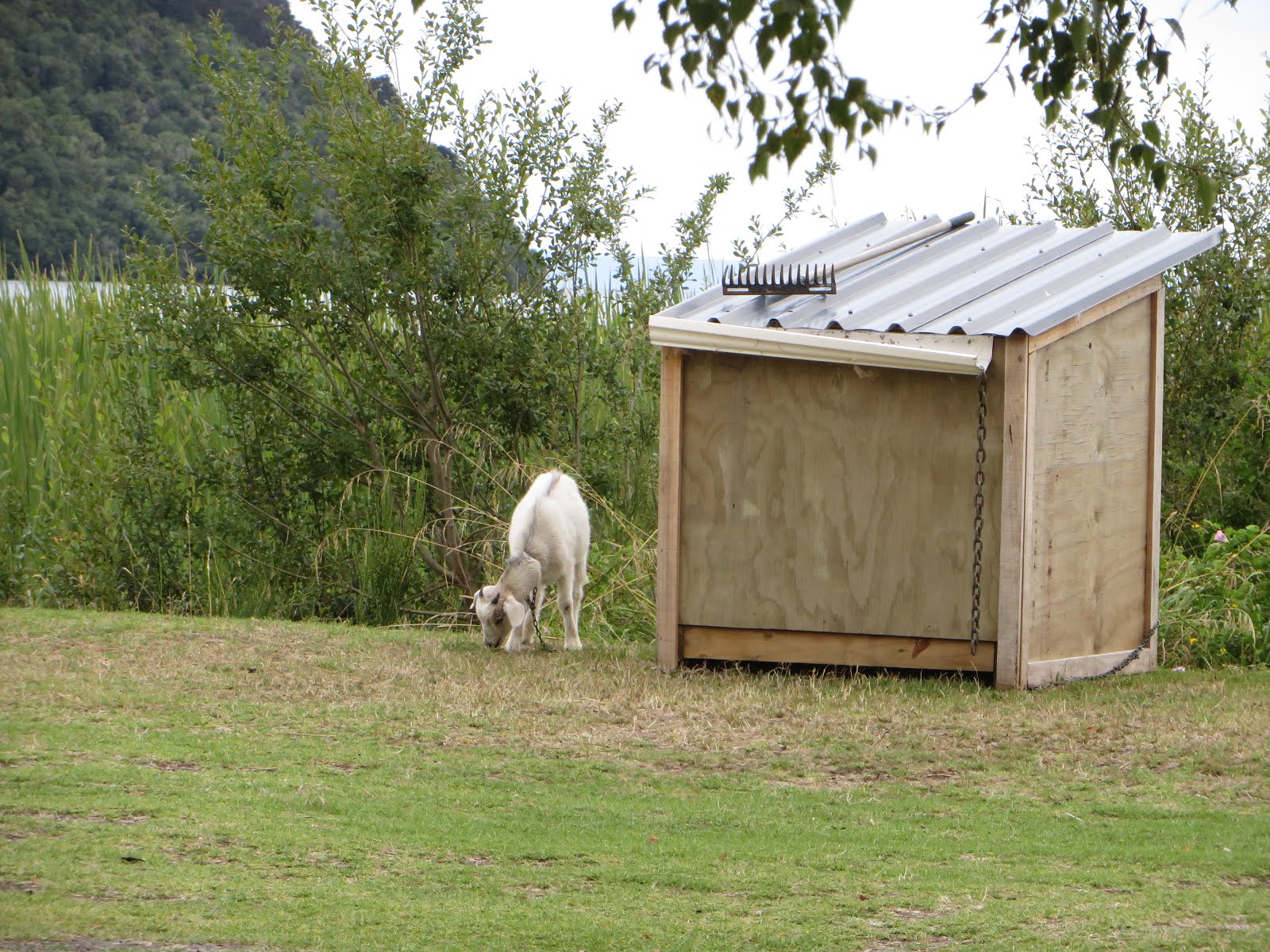
Lone goat, not sure why it was stationed there but it had a great lake view

On Tuesday we packed up our wet tent (because of course it started raining during the night) and headed back up to Taupo.  After hanging out at a café for a while we drove the short distance to Huka Falls, a gorge through which the Waikato River passes on its way to Auckland (NZ’s longest river).  It really was an impressive sight, seeing this pale blue water rush through the gorge.  Apparently kayakers will sometimes attempt passage, but we didn’t get to see that.

A little downstream the river is dammed for hydroelectric power with timed releases of water below.  We made our way to RapidsJet, a jetboat ride that goes along the river below the dam. Jetboats were invented in NZ and go very fast.  It's sort of a thrill ride involving lots of fast turns, jetting over rapids and back up rapids and getting soaked.  The guide did give us a little history about the river pointing out where some scenes from the Yogi bear movie were filmed and how they filmed the barrel over the falls scene in the second Lord of the Rings movie.  Most interesting to me was the clear cutting of pines along the banks of the river.  According to our guide the pines were planted after ranchers discovered the soil lacked nutrients needed to keep cattle healthy.  Many generations of pines have been planted and harvested.  Now though they have better fertilizers available so they are starting to bulldoze out the pine roots and replant pasture grasses.  So goes another cycle of farming.

Jake's Memorable New Zealand List

Jake's Memorable New Zealand List.

1.  Norfolk cellphone towers.
2.  A beanbag chair nap at a Maori cultural event (Auckland).
3.  Green-lipped mussels (Devonsport).
4.  New Zealand Reserve Bank Museum  Keynesian-based, water-powered macroeconomic projection machine (MONIAC -- "Monetary National Income Analogue Computer") (Wellington).
5.  A hike in a sulfurous wasteland (formerly a landfill in Rotorua).
6.  Wilson Abel Tasman Tours incredibly awesome logistical system.
7.  Great carrot cake  (everywhere).
8.  Tens of thousands (no kidding!) of waterfalls plunging over 2000 feet to the ocean (Milford Sound).


Waitomo Caves


Log chopping contest - who knew you had to wear white pants and a black muscle shirt?
From the Coromandel Peninsula we drove to Waitomo Caves near the eastern shore of the North Island.  As seems to be the norm for us, our first night of camping involved a tremendous thunderstorm before dinner followed by a 6:30 am wake up call by chainsaw.  At first we thought they were getting ready for a resumption of the logging contest from the day before, but it turned out they had just decided they should take down a hazardous tree early in the morning on a Sunday.  We have noticed that there are not many churches in NZ towns so far.

Turns out this weekend is another long weekend to celebrate Waitangi Day, the signing of a treaty between the Maori and the British.  This treaty is still seemingly enforced in that the Pacific Trade Agreement has been in dispute in the editorials because the treaty (and therefore the Maori) are not explicitly mentioned in the treaty.  We get the impression the Waitangi treaty says something about Maori businesses/farms being given some priority treatment.

Waitomo was high on my list of must see places because it is the place to see glow worms, in fact the larvae of an insect.  Our guide says ‘glow maggots’ just would not have brought in the same tourist base.  We did a tour with Spellbound because their max is 12 people/tour.  They have exclusive rights to use parts of 2 caves on private land.  Our group consisted of a couple from Vancouver, an Asian couple, a German couple, and 6 people from a hop on hop off bus tour company called Stray Bus, most of whom seemed to be from Europe. 

Our guide was a local from a family of 14 whom own an 800 acre farm in the area.    He had worked a lot of jobs including uprooting or cutting thistle on a sheep farm.   Then he worked as a truck driver before working as a guide.  He said the farmers had a tough time after the European Union formed because they couldn’t sell as much to Europe any more.  And in his words, in the 80s, “half the world became vegetarian and the other half ate only synthetic food”.  So when a farmer discovered he owned a great cave on his land he saw a good business opportunity.

glowworm threads
Glowworms (photo from Spellbound)
Eel attracted by pieces of a leftover meat pie
The first cave we went in to had a large glowworm population and river running through the cave (although we learned later that they artificially keep the water level high in the summer so they can continue rafting through part of the cave).  You walk through about half the cave on cement walkways and are pulled through the second half on a rubber raft.  The glowworms really are a sublime experience.  In total darkness they let off enough light to faintly see the white hard hats the people around you are wearing.  The ceiling is illuminated with greenish-blue pinpoints of light, something akin to LED lighting, reflected in the water below. 

In fact the larvae have a glowing tip on their rear ends which they can turn on or off.  When on, they hope to attract prey.  The build a silken cocoon and trail sticky threads that bead up with dew.  Flying insects get attracted to the light and caught in the sticky threads.  The larvae wind up the thread and eat the caught insect.  They will eat adult glowworms and other smaller glowworm larvae too.
Moa bones
After tea and cookies, we went to the second cave where there are few glowworms but more cave formations such as stalactites and stalagmites and cave coral.  There are sink holes where plants and animals have fallen in, including the bones of one of the now extinct moas (a bird like an ostrich).  Farmers often discovered caves when one of their stock fell in, and the local caving society was essentially formed by people skilled in rescuing fallen animals according to our guide. 
Just inside the second cave

Details:.

Tented at the Waitomo Top 10 Holiday Park, very neat and clean, sites are very close to each other.  The cabins looked nice. Ate dinner at Hutu Café right next to the Holiday Park – very good dishes, local beer.  The General Store has decent snacks.